
Focus is the art of knowing what to ignore.
James Clear
Now a days it is very rare to see any training related to mediation without using power point.
Many potential trainers ask this question: “Should we compulsorily use power point presentation in order to be best trainers? The answer is a clear “NO”.
Some others ask this question – “What is wrong in using Power point Presentation?” The answer is “NOTHING WRONG”.
However, the following guidelines may be considered while using power point presentation:
- Slides should be complementary to what the trainer is communicating orally.
- The slides should be prepared in such a manner that trainees should not be focusing only on the slides, completely ignoring what the trainer is speaking.
- It is better to use only one or two key points or one or two key words on one slide.
- Slide should not be over crowded.
- Slide should not be filled like a newspaper.
- Slides can be used in the following circumstances:
- While introducing some technical words, which the trainees may be hearing for the first time. Ex. BATNA – BEST ALTERNATIVE TO NEGOTIATED AGREEMENT”; “REACTIVE DEVALUATION”
- Slides can also be used to show some pictures.
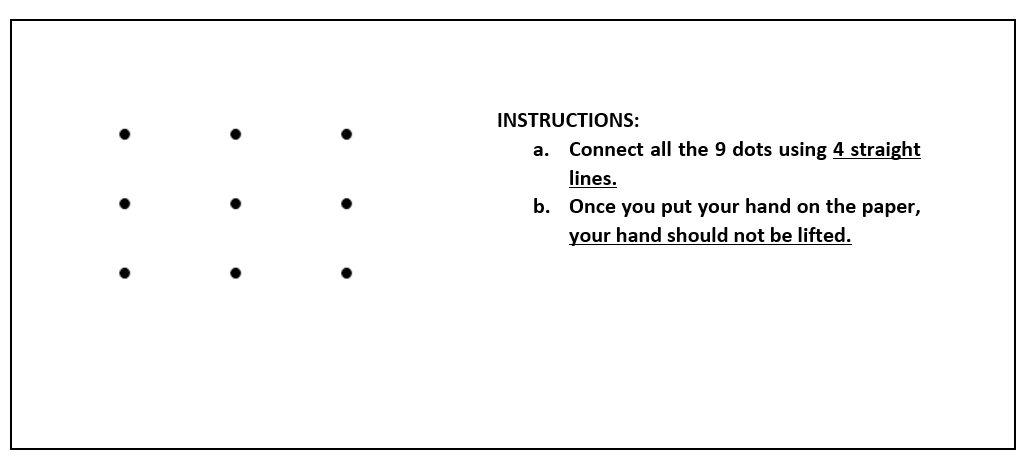
- Slides can be used to give clear instructions:
Example: Exercise on thinking out of the Box / Nine Dots’ Exercise

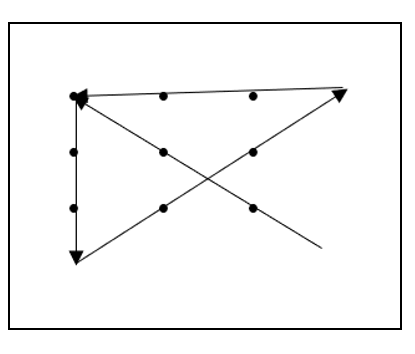
Right below the above slide you can show a slide with the solution.
- Slides can be used to make the trainees “read a quote”.
- Some portions of some judgments can be displayed on the slide. Where the reading material is lengthy trainer has to allow sufficient time to the trainees to read the same and understand the same.
To be avoided
1. Being controlled by the power point
Often many trainers start their presentation with the power point and allow the power point to control them. We have seen some trainers being unable to continue their session when the file format on the trainer’s pen drive did not match with the software in the system provided in the training venue.
Some could not continue and refused to continue the session when suddenly the power supply failed.
Some trainers feel very nervous if the technical support to use the power point presentation fails for any reason/s.
“Content knowledge should be in the heart and mind of a trainer”.
2. Reading word by word from the slides
Some trainers collect all the material on a given subject/topic. Load them on the slides. project them. Start reading them word by word. Occasionally, they translate the material on the slides in vernacular language. Such performance makes the trainer lose his/her credibility.
Example
A trainer was just reading word by word from the slide and occasionally translating one or two sentences in vernacular language. Each session was about an hour and half. After two sessions on two continuous days, the trainees gave their frank feedback that “said trainer need not take any further sessions. If the trainer sends the material by mail, they can read it on their own”.
Some trainees boldly told the trainer, “We can get all these materials from google. We do not need you”
Trainer is not a sender of material from one source to another.
3. Loading the slide with information not understood by the trainer
Some trainers collect information from several sources and load the same on the slides without understanding the same. When a trainee asks what a particular terminology means they remain clueless. Before preparing the slide, trainer has to clearly understand the content he/she is intending to project through the slides.
Example
A trainer had got about 40 overloaded slides prepared on the topic of negotiation and bargaining. A trainee asked a question “what do you mean by “ZERO SUM GAME”? The trainer was unable to explain.
“Think before you over ink” is the golden rule.
4. Using information which is not relevant to the given training
Trainer has to assess the need of the trainees. The objective of the training has to be well understood by the trainer. Enthusiasm to overload the trainees with unwanted or unnecessary information has to be curtailed.
Example
A trainer had used the words “Game Theory in Negotiation” in a training program. When a trainee asked what does it mean, trainer was stammering, as the trainer had not internalized the concept of Game Theory. But another trainee stood up and explained the concept very well.
“You cannot make others understand that which you have not understood”
(All copy rights reserved by the author S.Susheela)
 Training of Trainers in Mediation
Ma’am what personally i feel that slide presentation is not bad at all it helps imparting knowledge in a better way.Sometimes mere lecture methodology can be monotonous and distract trainees attention but slides can attract there attention and involves them in both audio visually.Ofcourse contents must be presented in a interesting manner.it should be
B E A R
Brief Educative Acceptable Reproducable.
LikeLike